
OPTICS
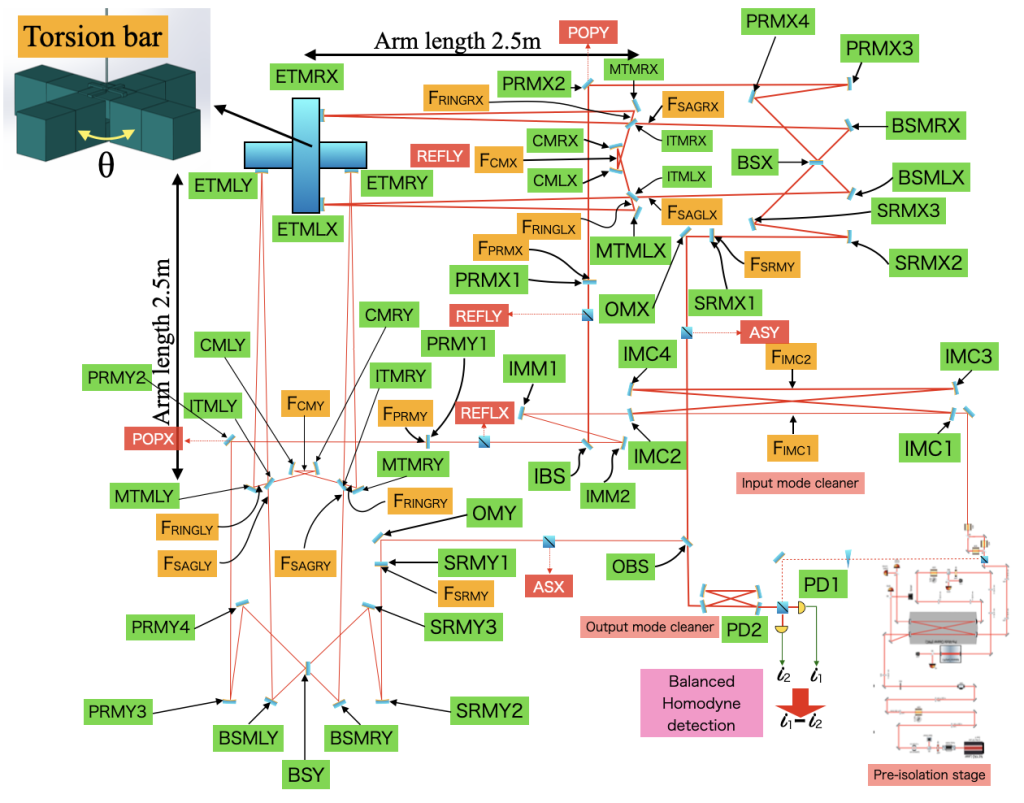
Overview
CHRONOS (Cryogenic sub-Hz cROss torsion-bar detector with quantum NOn-demolition Speed meter) is a prototype gravitational-wave detector designed to explore the sub-hertz frequency band (0.1–10 Hz).
The detector employs a Sagnac-type ring interferometer combined with torsion-bar test masses, enabling quantum non-demolition (QND) speed-meter measurements in the rotational degree of freedom.
The optical system integrates a torsion-bar–based main interferometer, power and signal recycling cavities, input and output mode cleaners, and balanced homodyne readout.
A key design feature of CHRONOS is that the signal recycling cavity is operated in a tuned configuration, while quantum noise reduction is achieved primarily through the intrinsic speed-meter response of the interferometer.
Torsion Bar and Main Interferometer
At the center of the interferometer are torsion-bar test masses with a rotational degree of freedom.
Gravitational waves induce a small angular displacement θ of the torsion bar, which is optically sensed by the interferometer.
The main interferometer is configured as a ring-type Sagnac interferometer with orthogonal arms of length 2.5 m.
Laser light propagates bidirectionally around the ring and acquires phase shifts associated with the rotational motion of the torsion bar.
This configuration provides sensitivity to the velocity of the test-mass motion rather than its position, allowing the interferometer to operate as a speed meter.
As a result, quantum radiation-pressure noise is intrinsically suppressed at low frequencies, which is essential for sub-hertz observations.
Power Recycling
Laser power is efficiently coupled into the interferometer using a set of power recycling mirrors (PRMs).
Power recycling increases the circulating optical power inside the interferometer, thereby reducing shot noise and improving sensitivity, particularly in the low-frequency regime relevant for CHRONOS.
Signal Recycling (Tuned SRC)
CHRONOS incorporates a Signal Recycling Cavity (SRC); however, the SRC is operated in a tuned (resonant) configuration and is not detuned.
In contrast to conventional Michelson-based detectors, where SRC detuning is often used to shape the frequency dependence of quantum noise, CHRONOS relies on:
- the intrinsic speed-meter response of the Sagnac interferometer,
- the rotational dynamics of the torsion-bar test masses, and
- balanced homodyne readout with adjustable detection phase,
to achieve low-frequency quantum noise suppression.
In this design, the SRC primarily enhances signal extraction efficiency rather than performing frequency-dependent quantum noise shaping.
Operating the SRC in a tuned configuration simplifies both the optical layout and the control system, improving stability in the low-frequency band.
Input and Output Mode Cleaners
To ensure high optical mode purity and frequency stability, CHRONOS employs:
- an Input Mode Cleaner (IMC), and
- an Output Mode Cleaner (OMC).
The IMC suppresses higher-order spatial modes and frequency noise of the laser before injection into the main interferometer.
The OMC filters the interferometer output, transmitting only the desired signal mode while rejecting unwanted spatial modes generated within the interferometer.
Readout: Balanced Homodyne Detection
The interferometer output is read out using balanced homodyne detection.
By interfering the signal beam with a local oscillator (LO), the detection quadrature can be freely chosen.
This flexibility allows the readout phase to be optimized for speed-meter operation and quantum noise minimization.
The final gravitational-wave signal is obtained from the difference of the two photodetector currents,
Design Philosophy
The optical system of CHRONOS integrates:
- a rotational degree of freedom as the gravitational-wave signal carrier,
- a Sagnac speed-meter interferometer for QND measurement,
- a tuned signal recycling cavity for efficient signal extraction, and
- balanced homodyne readout for optimal quantum noise performance.
This architecture provides a stable and conceptually simple platform for demonstrating low-frequency quantum noise suppression without relying on SRC detuning.
CHRONOS serves as a technology pathfinder for future ground-based gravitational-wave detectors targeting the sub-hertz band.